250/500CC 2/4-takt GP och övriga GPcc

steffe

"Mannen som talar med whisky"
Gick med
11 Jul 2009
Ort
Sigtuna
Hoj
-86 Suzuki GSX-R 750, -91 1100R
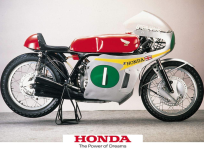
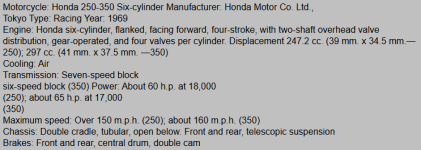
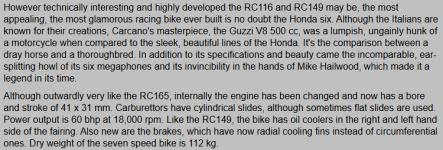
In 1964, Honda unleashed a six-cylinder 250cc four-stroke that dominated Grand Prix racing. Yamaha's twin-cylinder RD56 couldn't keep up. So Yamaha's engineers did something beautifully literal: they took two of their proven 125cc RA97 twin-cylinder two-stroke engines, stacked one on top of the other, and created a 249cc V4 with a 70-degree bank angle. Four rotary-disc valves. Four expansion chambers. Liquid cooling. Each cylinder displacing just over 62 cc, roughly the volume of an espresso cup. The result was the RD05, Yamaha's first V4, built for one purpose: to beat Honda's RC166 six-cylinder at the highest level of motorcycle Grand Prix racing.
The RD05 debuted at the 1965 Italian GP at Monza. It was fast but unreliable. Liquid cooling was added at the next round. Its only GP victory in 1966 came at the Japan GP. Honda's six-cylinder still dominated the 250cc championship. For 1967, Yamaha completely re-engineered the machine as the RD05A. Every possible component was redesigned to reduce weight and size. The rotary-disc valve induction gave each cylinder its own precisely timed intake system, allowing superior cylinder filling compared to piston-port two-strokes. Liquid cooling maintained stable temperatures under sustained racing conditions, enabling higher compression and more aggressive port timing. Output: approximately 60 HP at over 13,000 RPM from 249cc, an extraordinary specific output for the era. Four expansion chambers tuned for the narrow powerband where the two-stroke made its peak power.
The 1967 season became one of the greatest championship battles in motorcycle racing history. Phil Read and Bill Ivy rode the RD05A for Yamaha. Mike Hailwood rode the six-cylinder Honda RC166. Read won six rounds. Hailwood won five. Going into the final round at the Japan GP, both riders were tied on 50 points. Then both no-pointed in the finale. Honda's Ralph Bryans won the race. Hailwood took the title on countback (more wins: five to Read's four). Yamaha lost the Manufacturers' Championship to Honda by one point. In 1968, with Honda having withdrawn from Grand Prix racing, Read won the 250cc World Championship on the RD05A and Yamaha took the Constructors' title. Ivy finished second. The V4 had proven itself.
The FIM killed the RD05A. New regulations announced for the 1970 season limited 250cc Grand Prix machines to two cylinders. The governing body was explicitly trying to stop the technology war between Japanese factories that had produced V4 two-strokes and six-cylinder four-strokes in a 250cc class. Honda withdrew after 1967. Suzuki withdrew after 1967. Yamaha stayed through 1968, won the championship, then transitioned to the twin-cylinder TD production racers that would carry two-stroke dominance through the next three decades. The RD05's legacy wasn't the V4 layout itself. It was the validation that two-stroke technology, pushed to its absolute limit, could consistently defeat larger, more complex four-strokes at the pinnacle of Grand Prix racing. Every two-stroke GP champion from 1970 to 2001 raced on that foundation.
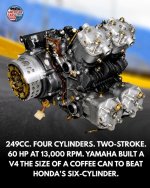
YammaV4-2T.jpg

Ska kolla efter info om Hondas 6'a och Suzukis motorer
 
Last edited:
De brukar återkomma till Hondas 60-talsracers i Cycleworlds podcast.
Den enda podcast jag alltid lyssnar på i 1,5x hastighet...
 
Jag kan rekommendera att läsa den här boken om hur George Beale byggde en Honda RC174 300 cc sexa, en otrolig bedrift och ett fantastiskt ingenjörsarbete.
Motorns lager var i olika storlekar ju längre ut på veven man kommer, oljekanaler som hårstrån, gjuta en förgasarbank helt i magnesium…
Toleranserna i motorn var så små att man har svårt att återskapa dem även med moderna verktyg, sjukt imponerande!!!

 
Oldie:

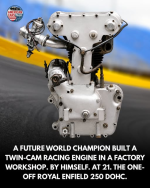
Bill Lomas was 21 years old when he designed and built a twin-cam cylinder head for a Royal Enfield 250 in 1949. He did it by hand, in Royal Enfield's competitions department workshop in Redditch, England, where he had landed a job after completing his National Service in the Royal Electrical and Mechanical Engineers. He was inspired by the 250 Benelli Grand Prix engine. He had no formal engineering degree. He had a pre-war Royal Enfield frame that his father had acquired from Michael McEvoy's bankrupt business in 1939, a 250cc OHV single-cylinder Enfield engine, and the conviction that the pushrod valvetrain was holding him back. So he designed a DOHC cylinder head, built it, and bolted it on. The only one of its kind.
The pushrod version of the engine, which Lomas had developed himself, made 23 HP at 7,800 RPM on pump fuel, an excellent number for a 250cc single in the late 1940s. The twin-cam head was only slightly more powerful in peak output, but it revved higher and safer. The DOHC design allowed more precise valve control at elevated RPM without the valve float that plagued pushrod heads at the limits of their operating range. For a racer competing at circuits like Cadwell Park, where sustained high-RPM running through fast corners determined the result, the ability to hold redline safely for longer was worth more than a few extra peak horsepower.
The results were immediate. Lomas won the Cadwell Park 250cc Championship in 1948, 1949, and 1950. He also won the 350cc and 500cc championships at the same circuit (using JAP-engined Royal Enfield specials: a 350cc and later a 500cc JAP racing motor in the same family of frames). He swept three displacement classes at one track for three consecutive years. His dominance at Cadwell Park and other British circuits led to offers of rides in Continental Grands Prix and at the Isle of Man TT. By the mid-1950s, Lomas had signed with Moto Guzzi's factory team. He won the 350cc World Championship in 1955 and again in 1956. A two-time World Champion whose career began with a hand-built twin-cam cylinder head on a 250cc Royal Enfield.
Lomas restored the motorcycle himself in 1979. The Bonhams auction house offered the complete machine (with both the pushrod and twin-cam engines) through the Lomas family in 2013. Old Bike Mart called it "the 250cc 'double-knocker' Royal Enfield designed by himself, and the only one of its kind." One engine. One head. One builder. One motorcycle. Three championships. Two World Titles. The hand-built DOHC Royal Enfield 250 is one of the rarest and most historically significant British racing engines in existence: not because a factory built it, but because a 21-year-old rider built it himself, won everything in sight, and used it as a launching pad to become a World Champion.

1784438555026.png
 
HONDA NSR500

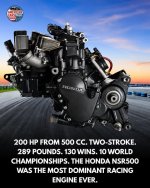
The most successful racing engine of the last 40 years isn't a V8. It isn't American. It has no pistons going up and down in the conventional sense. It's a 499 cc two-stroke V4 from Honda that weighs 289 pounds fully fueled, makes over 200 HP, and won 130 Grand Prix races and 10 World Championships between 1984 and 2002. The Honda NSR500. If you follow American motorsport, you've probably never heard of it. If you follow motorcycle Grand Prix racing, you know it's the most dominant racing engine in the history of the sport. More wins than the Cosworth DFV. More championships than any NASCAR engine. From half a liter.
The NSR500 replaced Honda's NR500, one of the most ambitious failures in racing history. The NR500 used oval pistons (each piston was shaped like a racetrack oval with two connecting rods per piston and eight valves per cylinder) to circumvent the four-cylinder limit in 500cc Grand Prix racing. It was brilliant engineering that didn't work on track. Honda abandoned the oval-piston concept and built a conventional 499 cc two-stroke V4 instead. Bore: 54 mm. Stroke: 54.5 mm. Nearly square. 90-degree V-angle initially (later opened to 112 degrees to improve exhaust pipe routing). Reed-valve induction. Single crankshaft (the predecessor NS500 triple used dual crankshafts). Initial output: 142 HP in 1984. By the early 1990s: over 200 HP. By 2001: 185 HP on unleaded fuel (regulations forced the switch from leaded). Weight of the complete motorcycle: 131 kg (289 lbs) dry. Power-to-weight ratio: approximately 1.4 HP per kilogram. A Bugatti Veyron makes 0.64.
The engineering breakthrough came in 1992 with the "Big Bang" firing order. Honda's engineers discovered that firing all four cylinders within 70 degrees of crankshaft rotation instead of spacing them evenly at 180 degrees gave the rear tire a brief recovery period between power pulses, dramatically improving traction. The tire wasn't being hammered continuously by power strokes. It was being hit, then given a moment to recover grip, then hit again. Mick Doohan won five of the first seven races in 1992 with the Big Bang engine before a catastrophic crash at Assen broke his right leg so severely that doctors considered amputation. Doohan kept the leg. He came back. From 1994 to 1998, he won five consecutive 500cc World Championships on the NSR500, including 12 of 15 races in 1997, breaking the single-season win record. 54 career victories. One man. One engine. The most dominant rider-machine combination in modern motorcycle racing history.
The NSR500's rider list reads like a hall of fame. Freddie Spencer (1985 champion, simultaneously won the 250cc and 500cc titles in the same season, the only rider ever to do it). Wayne Gardner (1987, first Australian 500cc champion). Eddie Lawson (1989, switched from Yamaha and won the title immediately). Doohan (1994-1998, five consecutive). Alex Crivillé (1999, first Spanish 500cc champion). Valentino Rossi (2001, 11 wins in 16 races in his final two-stroke season before switching to MotoGP's four-stroke RC211V). The NSR500 competed in its final season in 2002, running against the new 990cc four-stroke MotoGP machines with twice the displacement. It still won races. The last competitive two-stroke Grand Prix engine. 130 wins. 10 championships. 200 HP from 500 cc. 289 pounds. The greatest racing engine most Americans have never heard of.

HondaNSR500_2-stroke.jpg
 
HONDA NSR500

The most successful racing engine of the last 40 years isn't a V8. It isn't American. It has no pistons going up and down in the conventional sense. It's a 499 cc two-stroke V4 from Honda that weighs 289 pounds fully fueled, makes over 200 HP, and won 130 Grand Prix races and 10 World Championships between 1984 and 2002. The Honda NSR500. If you follow American motorsport, you've probably never heard of it. If you follow motorcycle Grand Prix racing, you know it's the most dominant racing engine in the history of the sport. More wins than the Cosworth DFV. More championships than any NASCAR engine. From half a liter.
The NSR500 replaced Honda's NR500, one of the most ambitious failures in racing history. The NR500 used oval pistons (each piston was shaped like a racetrack oval with two connecting rods per piston and eight valves per cylinder) to circumvent the four-cylinder limit in 500cc Grand Prix racing. It was brilliant engineering that didn't work on track. Honda abandoned the oval-piston concept and built a conventional 499 cc two-stroke V4 instead. Bore: 54 mm. Stroke: 54.5 mm. Nearly square. 90-degree V-angle initially (later opened to 112 degrees to improve exhaust pipe routing). Reed-valve induction. Single crankshaft (the predecessor NS500 triple used dual crankshafts). Initial output: 142 HP in 1984. By the early 1990s: over 200 HP. By 2001: 185 HP on unleaded fuel (regulations forced the switch from leaded). Weight of the complete motorcycle: 131 kg (289 lbs) dry. Power-to-weight ratio: approximately 1.4 HP per kilogram. A Bugatti Veyron makes 0.64.
The engineering breakthrough came in 1992 with the "Big Bang" firing order. Honda's engineers discovered that firing all four cylinders within 70 degrees of crankshaft rotation instead of spacing them evenly at 180 degrees gave the rear tire a brief recovery period between power pulses, dramatically improving traction. The tire wasn't being hammered continuously by power strokes. It was being hit, then given a moment to recover grip, then hit again. Mick Doohan won five of the first seven races in 1992 with the Big Bang engine before a catastrophic crash at Assen broke his right leg so severely that doctors considered amputation. Doohan kept the leg. He came back. From 1994 to 1998, he won five consecutive 500cc World Championships on the NSR500, including 12 of 15 races in 1997, breaking the single-season win record. 54 career victories. One man. One engine. The most dominant rider-machine combination in modern motorcycle racing history.
The NSR500's rider list reads like a hall of fame. Freddie Spencer (1985 champion, simultaneously won the 250cc and 500cc titles in the same season, the only rider ever to do it). Wayne Gardner (1987, first Australian 500cc champion). Eddie Lawson (1989, switched from Yamaha and won the title immediately). Doohan (1994-1998, five consecutive). Alex Crivillé (1999, first Spanish 500cc champion). Valentino Rossi (2001, 11 wins in 16 races in his final two-stroke season before switching to MotoGP's four-stroke RC211V). The NSR500 competed in its final season in 2002, running against the new 990cc four-stroke MotoGP machines with twice the displacement. It still won races. The last competitive two-stroke Grand Prix engine. 130 wins. 10 championships. 200 HP from 500 cc. 289 pounds. The greatest racing engine most Americans have never heard of.

View attachment 530877
Ett sakfel i deras text NSR500 ersatte inte NR500 utan de hade NS500 och privathojarna hette RS500.

NS betydde New Sprint.
 
Minarelli

Winning 500cc Grand Prix races against Yamaha and Suzuki demanded more than raw horsepower—it required engineering brilliance. The Morbidelli 500/4 GP represented Italy's bold attempt to challenge the world's biggest factories with one of the most sophisticated two-stroke racing engines ever conceived.
At its heart was a 498cc water-cooled square-four two-stroke engine, utilizing four cylinders arranged in a compact square configuration and tilted forward approximately 40 degrees to improve mass centralization and aerodynamics. Compact dimensions and an aggressive design philosophy made the engine one of the most technically ambitious Grand Prix powerplants of its era.
The engine measured 55 mm × 52 mm for its bore and stroke, combining a short-stroke layout with a 13:1 compression ratio that allowed it to spin safely into the upper reaches of the rev range. In its ultimate development under renowned engineer Jörg Möller, the Morbidelli produced approximately 130 horsepower at 11,500 rpm, placing it among the most powerful Grand Prix motorcycles of the period.
Fuel delivery came through four 34 mm Mikuni carburetors, each feeding a rotary disc-valve induction system. Unlike piston-port or reed-valve engines, rotary discs allowed extremely precise intake timing, maximizing cylinder filling at high engine speeds and delivering the explosive throttle response demanded in premier-class racing.
Lightweight construction was another priority. Early engines featured magnesium crankcases and compact internal components to minimize mass. When Jörg Möller assumed development around 1980, he strengthened numerous internal assemblies to improve durability. Although the revised engine gained roughly 10 kilograms, the improvements significantly increased reliability during the demanding Grand Prix season.
Installed in a motorcycle weighing approximately 135 kg, the Morbidelli 500/4 was capable of reaching nearly 290 km/h (180 mph) on the fastest circuits. Its screaming square-four exhaust note and razor-sharp power delivery made it every bit as dramatic as its Japanese rivals.
Despite its remarkable engineering, the Morbidelli ultimately struggled against the enormous development budgets and continuous evolution of Yamaha and Suzuki's factory programs. Yet the project remains a symbol of Italian innovation—proving that a small independent manufacturer could
build a world-class Grand Prix engine capable of challenging the giants of motorcycle racing.

1785132824261.png
 
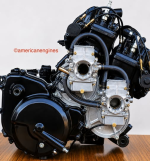
Suzuki RG500

This Suzuki RG500 engine is one of the most legendary two-stroke racing powerplants ever built, dominating Grand Prix motorcycle racing throughout the late 1970s and early 1980s. Developed specifically for the 500cc World Championship, the liquid-cooled square-four engine powered some of the sport's greatest riders, including Barry Sheene, Marco Lucchinelli, and Franco Uncini, to multiple world titles. Its remarkable combination of lightweight construction, explosive power, and exceptional reliability made the RG500 the benchmark against which all other Grand Prix motorcycles were measured, cementing Suzuki's place among the elite manufacturers in motorcycle racing history.
At the heart of the RG500 was a 498cc liquid-cooled square-four two-stroke engine consisting of two parallel-twin crankshafts geared together to create a remarkably compact package. Featuring rotary-disc valve induction on early factory versions and later developments incorporating advanced intake and exhaust technologies, the engine produced well over 120 horsepower in works specification while revving beyond 11,000 rpm. The square-four configuration offered excellent balance, a narrow engine profile, and outstanding power delivery, enabling engineers to optimize chassis geometry and handling. Combined with lightweight construction and finely tuned expansion chambers, the RG500 delivered the blistering acceleration and razor-sharp responsiveness that defined the golden era of Grand Prix racing.
Today, the Suzuki RG500 engine remains one of the most admired racing engines ever created. Its unmistakable high-pitched exhaust note, innovative engineering, and championship-winning pedigree have earned it legendary status among collectors and vintage racing enthusiasts worldwide. Original factory race engines are exceptionally rare and highly prized, while the road-going RG500 Gamma introduced much of the same technology to production motorcycles, allowing enthusiasts to experience a taste of Grand Prix performance. More than four decades after its peak, the RG500 continues to symbolize Suzuki's engineering excellence and the unforgettable excitement of the two-stroke Grand Prix era.

1785132923805.png
 
Nyheter
Premiär för Östgöta Dundret

Under 1940 talet var Finspå...

Ny 500-kubiks retro från Honda

Efter rykten om en ny retro...

Ny 500-kubiks retro från Honda

Efter rykten om en ny retro...

Ny 500-kubiks retro från Honda

Efter rykten om en ny retro...

Nya BMW S 1000 RR tar form

Redan i maj 2025 gav BMW me...

Helsvarta Deadwood – Ny cruiser från H-D

H-D presenterar nya Deadwoo...

Sommarauktion hos Antiqueweb

Svenska Antiqueweb avslutar...

HJC stärker kundrelationen

Pressrelease från HJC Helme...

Sportsterbygge i nästa nummer

I Allt om MC nummer 8 komme...

Dags för gräsgasa hos Hydet

Den 1 augusti kör Hydet MC ...

Back
Top