

steffe
"Mannen som talar med whisky"
DKW 250cc 2t Ladepumpe
The 1930s DKW 250 Ladepumpe is seriously impressive for its time. What looks like a simple single-cylinder two-stroke is actually a very unusual split-single design with a separate charging piston, giving it three pistons working within the engine concept. The extra pumping piston compressed the incoming mixture before feeding the main cylinder, letting DKW push far more charge into the combustion chamber than a normal naturally aspirated two-stroke of the era.
The really clever part is the Ladepumpe itself. DKW could use forced induction without simply adding a conventional blower, while the split-piston arrangement also gave the engineers more control over the intake and exhaust timing. That was a big deal with two-strokes because controlling fresh-charge losses was a major challenge. The factory racing versions were developed aggressively, with the later 250cc machines reaching around 35 hp at 7,000 rpm, while the customer SS 250 was already making about 20 hp in its earlier form.
And that's what makes this engine so unique. A 250cc two-stroke with multiple pistons, a built-in charging pump, liquid cooling, and race-developed forced induction sounds almost crazy even by today's standards. It wasn't the simplest design, but DKW was trying to squeeze every possible bit of performance from two-stroke technology in the 1930s. Tiny displacement, extremely clever mechanics, and a design that looks completely different from a normal motorcycle engine.
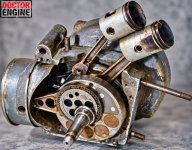
The 1930s DKW 250 Ladepumpe is seriously impressive for its time. What looks like a simple single-cylinder two-stroke is actually a very unusual split-single design with a separate charging piston, giving it three pistons working within the engine concept. The extra pumping piston compressed the incoming mixture before feeding the main cylinder, letting DKW push far more charge into the combustion chamber than a normal naturally aspirated two-stroke of the era.
The really clever part is the Ladepumpe itself. DKW could use forced induction without simply adding a conventional blower, while the split-piston arrangement also gave the engineers more control over the intake and exhaust timing. That was a big deal with two-strokes because controlling fresh-charge losses was a major challenge. The factory racing versions were developed aggressively, with the later 250cc machines reaching around 35 hp at 7,000 rpm, while the customer SS 250 was already making about 20 hp in its earlier form.
And that's what makes this engine so unique. A 250cc two-stroke with multiple pistons, a built-in charging pump, liquid cooling, and race-developed forced induction sounds almost crazy even by today's standards. It wasn't the simplest design, but DKW was trying to squeeze every possible bit of performance from two-stroke technology in the 1930s. Tiny displacement, extremely clever mechanics, and a design that looks completely different from a normal motorcycle engine.


