steffe
"Mannen som talar med whisky"
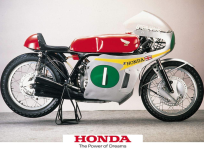
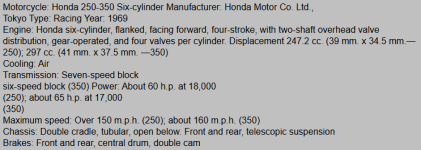
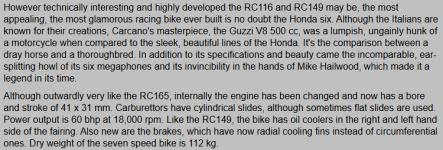
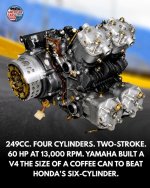
In 1964, Honda unleashed a six-cylinder 250cc four-stroke that dominated Grand Prix racing. Yamaha's twin-cylinder RD56 couldn't keep up. So Yamaha's engineers did something beautifully literal: they took two of their proven 125cc RA97 twin-cylinder two-stroke engines, stacked one on top of the other, and created a 249cc V4 with a 70-degree bank angle. Four rotary-disc valves. Four expansion chambers. Liquid cooling. Each cylinder displacing just over 62 cc, roughly the volume of an espresso cup. The result was the RD05, Yamaha's first V4, built for one purpose: to beat Honda's RC166 six-cylinder at the highest level of motorcycle Grand Prix racing.
The RD05 debuted at the 1965 Italian GP at Monza. It was fast but unreliable. Liquid cooling was added at the next round. Its only GP victory in 1966 came at the Japan GP. Honda's six-cylinder still dominated the 250cc championship. For 1967, Yamaha completely re-engineered the machine as the RD05A. Every possible component was redesigned to reduce weight and size. The rotary-disc valve induction gave each cylinder its own precisely timed intake system, allowing superior cylinder filling compared to piston-port two-strokes. Liquid cooling maintained stable temperatures under sustained racing conditions, enabling higher compression and more aggressive port timing. Output: approximately 60 HP at over 13,000 RPM from 249cc, an extraordinary specific output for the era. Four expansion chambers tuned for the narrow powerband where the two-stroke made its peak power.
The 1967 season became one of the greatest championship battles in motorcycle racing history. Phil Read and Bill Ivy rode the RD05A for Yamaha. Mike Hailwood rode the six-cylinder Honda RC166. Read won six rounds. Hailwood won five. Going into the final round at the Japan GP, both riders were tied on 50 points. Then both no-pointed in the finale. Honda's Ralph Bryans won the race. Hailwood took the title on countback (more wins: five to Read's four). Yamaha lost the Manufacturers' Championship to Honda by one point. In 1968, with Honda having withdrawn from Grand Prix racing, Read won the 250cc World Championship on the RD05A and Yamaha took the Constructors' title. Ivy finished second. The V4 had proven itself.
The FIM killed the RD05A. New regulations announced for the 1970 season limited 250cc Grand Prix machines to two cylinders. The governing body was explicitly trying to stop the technology war between Japanese factories that had produced V4 two-strokes and six-cylinder four-strokes in a 250cc class. Honda withdrew after 1967. Suzuki withdrew after 1967. Yamaha stayed through 1968, won the championship, then transitioned to the twin-cylinder TD production racers that would carry two-stroke dominance through the next three decades. The RD05's legacy wasn't the V4 layout itself. It was the validation that two-stroke technology, pushed to its absolute limit, could consistently defeat larger, more complex four-strokes at the pinnacle of Grand Prix racing. Every two-stroke GP champion from 1970 to 2001 raced on that foundation.
Ska kolla efter info om Hondas 6'a och Suzukis motorer
The RD05 debuted at the 1965 Italian GP at Monza. It was fast but unreliable. Liquid cooling was added at the next round. Its only GP victory in 1966 came at the Japan GP. Honda's six-cylinder still dominated the 250cc championship. For 1967, Yamaha completely re-engineered the machine as the RD05A. Every possible component was redesigned to reduce weight and size. The rotary-disc valve induction gave each cylinder its own precisely timed intake system, allowing superior cylinder filling compared to piston-port two-strokes. Liquid cooling maintained stable temperatures under sustained racing conditions, enabling higher compression and more aggressive port timing. Output: approximately 60 HP at over 13,000 RPM from 249cc, an extraordinary specific output for the era. Four expansion chambers tuned for the narrow powerband where the two-stroke made its peak power.
The 1967 season became one of the greatest championship battles in motorcycle racing history. Phil Read and Bill Ivy rode the RD05A for Yamaha. Mike Hailwood rode the six-cylinder Honda RC166. Read won six rounds. Hailwood won five. Going into the final round at the Japan GP, both riders were tied on 50 points. Then both no-pointed in the finale. Honda's Ralph Bryans won the race. Hailwood took the title on countback (more wins: five to Read's four). Yamaha lost the Manufacturers' Championship to Honda by one point. In 1968, with Honda having withdrawn from Grand Prix racing, Read won the 250cc World Championship on the RD05A and Yamaha took the Constructors' title. Ivy finished second. The V4 had proven itself.
The FIM killed the RD05A. New regulations announced for the 1970 season limited 250cc Grand Prix machines to two cylinders. The governing body was explicitly trying to stop the technology war between Japanese factories that had produced V4 two-strokes and six-cylinder four-strokes in a 250cc class. Honda withdrew after 1967. Suzuki withdrew after 1967. Yamaha stayed through 1968, won the championship, then transitioned to the twin-cylinder TD production racers that would carry two-stroke dominance through the next three decades. The RD05's legacy wasn't the V4 layout itself. It was the validation that two-stroke technology, pushed to its absolute limit, could consistently defeat larger, more complex four-strokes at the pinnacle of Grand Prix racing. Every two-stroke GP champion from 1970 to 2001 raced on that foundation.
Ska kolla efter info om Hondas 6'a och Suzukis motorer